
- Monday-Friday 8-6 CST1-800-276-6508
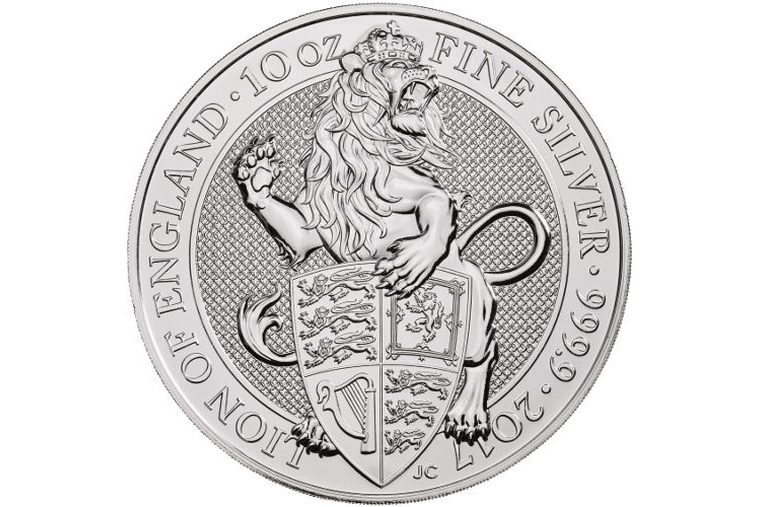
Royal coronations are historic events steeped in tradition and symbolism. When Queen Elizabeth II ascended to the throne in February 1952, ten heraldic guardians stood watch over the proceedings as a tangible nod to the new queen’s bloodline.
The Royal Mint immortalized those ten guardians in silver and gold through its Queen’s Beasts coin series. The bullion coin series quickly became one of the Royal Mint’s most beloved and celebrated modern series.
However, the Queen’s Beasts are not the only heraldic images celebrated on Royal Mint coinage. In the wake of the success of the Queen’s Beasts, the mint issued the Tudor Beasts series, which is a focused series that pays tribute to one of Britain’s greatest royal houses.
At a time when modern Great Britain is in flux, it’s important to keep the country’s proud history and traditions close in mind. So, let’s talk about these two great coin series and how they allow modern coin collectors to connect to the England of times past.
Elizabeth Windsor became Queen Elizabeth II on February 6, 1952 – the day that her father, King George VI, finally succumbed to cancer. However, her coronation did not take place until more than a year later due to royal tradition about a proper mourning period.
The official crowning of the new queen took place on June 2, 1953 at Westminster Abbey in London. The event was the first of its kind to be fully televised, and drew more than 8,000 attendees in person.
As part of the pageantry of the event, organizers displayed 10 six-foot stone statues to serve as symbolic guards over Queen Elizabeth II. Sculptor Arnold Machin created each statue to represent a portion of Elizabeth’s royal lineage.
In 2015, Elizabeth became the longest-serving monarch in British history. In doing so, she surpassed her grandmother, Queen Victoria, who reigned for more than 63 years.
As a tribute, the Royal Mint conceived the Queen’s Beasts to be a multi-year bullion coin series to pay homage to the queen’s lineal heralds. Each coin in the series is an important facet of the bloodlines that elevated Elizabeth to the throne.
However, they are also unique coin pieces in their own right. Here is a rundown on each member of the series.
The Queen’s Beasts Coin Series debuted in March 2016. Each coin featured a right-facing bust of Queen Elizabeth II on its obverse. The obverse design would remain the consistent feature of the series, albeit with a slight shift to its background imagery (from stucco-like to diamonds).
The reverse of the coins was the location of its namesake beast. Each release featured a heraldic representation of a named animal. In turn, each animal stood as an allegory for the Queen’s various bloodlines. The ten Queen’s Beasts coins, and their first bullion releases, were as follows:
Now, each coin was released in a variety of sizes, metals, and finishes. Queen’s Beasts sets were available in both bullion and proof versions.
You could also purchase them in gold, silver, platinum, and – unusually – cupronickel. However, the sizes available in each metal were not universal. Where the gold, platinum, and cupronickel versions were standard-made with 1 troy ounce, the silver version’s standard size was 2 oz.
The denominations of each metal’s bullion coin were the following –
The proof versions of the Queen’s Beasts coins, however, were almost a thing unto themselves. The proofs were available in both gold and silver, and bore the following denominations:
The proof versions also differed from the bullion Queen’s Beasts in a curious manner. Though the Lion of England was the first proof release and the Red Dragon of Wales was the third release, the Unicorn of Scotland replaced the Griffin of Edward III as the second proof coin to be released.
All other proof versions shifted down a notch from their previous release order. The Griffin of Edward III proof became the tenth and final proof version to be released. In other words, there was a four-year gap between the release of the Griffin of Edward III’s bullion and proof coins.
The final release in the series was an eleventh coin, known as The Completer. It featured a sort of mashup of the ten designs as a way to close out the collection.
No matter the finish or timing of the release, each expression of the Queen’s Beasts bears an ultrapure composition. The gold and silver versions are both minted to be .9999 fine, or “four nines fine.” The platinum version is only marginally less pure at .9995 fine.
All Queen’s Beasts are legal tender within the territories of the United Kingdom. Each one bears a face value ranging from £2 to £100, though the metal content of each coin significantly exceeds the listed value.
Because the Queen’s Beasts series proved to be so popular among collectors and investors, the Royal Mint immediately moved to introduce a new coin series that ran along similar lines. So, it decided to honor the Tudor dynasty of British royalty with the Tudor Beasts Coin Series.
In this case, the coin series includes ten new designs that come from the dynasty’s heraldic beasts. In other words, the ten animals depicted are representations of various bloodlines that fed into the Tudor dynasty. Statues of these beasts have stood guard on the Moat Bridge of the Hampton Court Palace, the ancestral home of the Tudor dynasty.
Now, there is some overlap between the beasts in the two coin series, as the Windsors do descend, in part, from the Tudors. There are also some shared beasts because some of them are broader representations of English history, which both dynasties share.
However, both the designs and the placement of the Tudor Beasts are significantly different from the Queen’s Beasts. Here are the Tudor Beasts and their years of release:
Needless to say, Tudor Beasts coins minted in 2022 or before feature Queen Elizabeth II on their obverse. All Tudor Beasts minted from 2023 to 2026 feature King Charles III, owing to Queen Elizabeth’s death in September 2022.
Like their predecessors, Tudor Beasts bear ultrahigh purities in each of their compositions. Gold and silver members are .9999 fine, while platinum editions are .9995 fine.
With the completion of the Tudor Beasts in 2026, the Royal Mint has finished a decade of coins paying homage both to its current monarchs and the millennia of royals that have come before. In many ways, the two coin series are a recap of British history, as we can effectively chart the course of the nation’s success according to the competence of its rulers.
Obviously, there is a great deal of appeal to these coins as both precious metal investments and numismatic pieces. In particular, they are seemingly tailor-made for collectors who wish to assemble discrete sets of coins. If the collectors or investors are enthusiasts of British history, there’s even more reason to buy.
While we cannot guarantee that we have every single member of the two sets at all times, JM Bullion is quite capable of getting you started. Peruse our selection and make your choices, or give us a call at 1-800-276-6508 (Weekdays, 8A – 6P Central) to talk about what you need.
Subscribe to the JM Bullion newsletter to receive timely market updates and information on product sales and giveaways.
Major Payment Methods Accepted

Download Our Free App Today


© Copyright 2026 JM Bullion. All Rights Reserved. Your Privacy Choices