

-
-
Monday-Friday 8-6 CST1-800-276-6508
The official gold coin of the United States, the American Gold Eagle coins are available on an annual basis in three familiar versions and four different weights. These stunning coins serve as a reminder of the majesty, longevity, and strength of the American nation. Each Gold Eagle coin from the United States Mint features images of the nation’s most iconic symbols, from its official national emblem of the American bald eagle to that towering symbol of freedom and democracy known to most simply as Lady Liberty.
When looking for gold for sale, the American Gold Eagle comes to mind for most numismatists and collectors. The coins are struck by the United States Mint, and the metal content and purity of each is guaranteed by the full faith and credit of the United States. Learn more about the American Gold Eagle below.
American Gold Eagle Coins were authorized for production by the United States Congress with passage of the Gold Bullion Coin Act of 1985. Under the terms of legislation, the program was to contain four different weights in total (1 oz, ½ oz, ¼ oz, 1/10 oz) and include two different versions initially (bullion and proof). Congress set the face value for the coins as is standard practice with any legal tender issued by the United States Mint.
The first American Gold Eagle coins were produced and made available for purchase in 1986. The bullion gold coin program was immediately available with all four weights, while the proof version of the coin featured only a 1 oz coin in 1986. The proof program expanded to include the ½ oz weight in 1987, and the ¼ oz and 1/10 oz coins in 1988.
For the 20th anniversary of the American Eagle coin series, which includes the Silver Eagle, in 2006, the United States Mint introduced a new burnished version of the coin. The Burnished American Gold Eagle was introduced specifically for coin collectors. Although the United States Mint already had the proof version of the Gold Eagle available for collectors, the burnished version of the coin had a unique minting process that gave it enhanced value for those numismatists interested in the display and exhibition of visually brilliant coins.
The United States Mint chose a historic American coinage design for the American Gold Eagle. Augustus Saint-Gaudens was hand-picked by President Theodore Roosevelt in 1905 to help revitalize US gold coinage with a brilliant new design.
Saint-Gaudens crowning achievement was the Lady Liberty design that features Liberty in full-length figure, her hair and robe flowing freely in the breeze as she strides forward confidently from the nation’s capital. In her right and left hand are a torch for light, and an olive branch signifying peace; all the things she’ll need to guide the nation toward a peaceful, if unknown, future.
His original design was used on the $20 Gold Double Eagle coin. In circulation from 1907 to 1933, it is considered the finest design on the greatest coin in American history. Saint-Gaudens himself never lived to see his design come to fruition on an American coin though, passing away due to complications from illness just months before the coins were released in 1907.
In Saint-Gaudens’ original design, Liberty was featured striding forward with the US Capitol Building at her feet, the rays of the setting sun at her back, and 46 stars surrounding her along the coin’s rim. In 1912, Congress authorized the addition of two stars to his design to recognize the addition of New Mexico and Arizona to the Union. In order for the image to be used on the American Gold Eagle, two stars were added to recognize the post-World War II addition of Hawaii and Alaska to the Union.
The reverse side of the coin features a family of nesting bald eagles, and was designed by Miley Busiek. In the image, a male bald eagle returns to the nest with branches in its talons. In the nest, a female is depicted standing vigilant guard over the young hatchlings in the nest. Busiek’s design was created in 1986, and is used exclusively on the American Gold Eagle.
To mark the 35th anniversary of the American Gold Eagle, the United States Mint offers a brand-new design on the reverse field of the coins for the first time in the history of the collection. Created by US Mint Artistic Infusion Program Artist Jennie Norris, the new design for the reverse features the following elements:
Jennie Norris is the designer of note whose artwork was chosen from a group of more than 34 designs to be the new face of the collection. Ms. Norris has a background as a professional graphic designer, illustrator, and award-winning artist. Her works have featured in the gift and stationery industry, as well as other retail products for the likes of Crayola, Sea World, Hasbro, Hershey, JoAnn Stores, Target, and Costco. In this particular design, Ms. Norris drew on her years of experience working as a volunteer raptor handler to capture the true beauty of the American bald eagle.
The leading product in the American Gold Eagle lineup is the bullion coin. As mentioned earlier, the bullion coin has been the most stable product in the lineup. It has been offered by the United States Mint every year, in all four weights, since its introduction in 1986. The bullion coins have followed a fairly predictable up-and-down mintage flow over the course of more than 30 years of availability.
When the bullion Gold Eagles were introduced in 1986, demand exceeded 1.3 million for the 1 oz coin alone, with the ½ oz, ¼ oz, and 1/10 oz coins hitting 599,000, 726,000, and 912,000 respectively. Demand for the coins cooled throughout the 1980s and early 1990s, before peaking again in the late 1990s and into the early 2000s. The early to mid-2000s saw another significant decline in mintage figures, until the onset of the Great Recession in 2008, when the gold eagles soared to new heights with mintage figures of 1.49 million, 110,000, 110,000, and 270,000 respectively from 1 oz down to 1/10 oz.
Mintage figures again dropped back down until 2014, with 2015 and 2016 both posting year-over-year gains in mintage. Most American Gold Eagle bullion coins are available at this time in BU condition from JM Bullion. A coin in BU condition exhibits no signs of wear and tear, though you may notice minor flaws ranging from breaks in the luster and spotted surfaces to contact marks from the coining process.
For those numismatists who love to collect gold coins, the Proof American Gold Eagles are an excellent cornerstone piece of any personal collection. The difference between bullion and proof coins is significant when it comes to the inherent value of the coin itself. All American Gold Eagle coins, regardless of style and finish, bear a face value reflective of the gold content by weight issued by the United States government.
However, the Proof American Gold Eagle coin has a greater value than even its bullion counterpart. All versions of the coin have a value well beyond their face value, holding a value that is in line with the price of gold and based upon the purity and metal content of the coin. For the Proof American Gold Eagle, value can soar well beyond even the bullion version with certification from one of the nation’s, and world’s, two most respected certification companies. You’ll find more information on Certified Gold Eagles later on.
While the Proof Gold Eagles have likewise seen ebbs and flows in their demand, actual mintage figures have swayed much less distinctly in numeric terms compared to the bullion coins. While bullion coinage has since drops of more than a million coins in mintage levels over certain five-year periods, the proof coins have always remained within roughly the same range from lows of 12,000 to highs of 45,000. Only a few years have seen mintage levels far exceeding those maximums.
It wasn’t until the 20th anniversary of the American Gold Eagle coin series in 2006 that the United States Mint expanded the program to include a special burnished coin. Aimed directly at numismatists who collect and display or exhibit their beloved American Gold Eagles, the Burnished American Gold Eagle (also referred to as an uncirculated Gold Eagle) is struck using a special coining process that is similar to the one used in the production of proof coins.
The United States Mint begins the coining process for burnished gold eagles by loading all of the blanks, known as planchets, into a spinning drum. In the past, this step in the process used wet sand as a friction agent that served as a polishing media to give the blanks a unique finish before even being struck. Today, the US Mint uses countless 6mm balls to create a smooth, matte-like finish on the surface of the blanks.
Once each blank has been sent through the spinning drum, the individual blanks are taken out one at a time by mint employees wearing white gloves. The blanks are transferred by hand, wearing gloves, to the coining press in order to avoid contaminating the finish of the blanks with oil and dirt from human skin. Each blank is then hand loaded into the coining press for striking. All blanks are struck under greater pressure than bullion coins and regular circulation currency, creating a striking finish.
Although the Burnished American Gold Eagle undergoes a similar coining process to proof coins, the appearance of these coins is often compared more closely to that of the bullion coin in the series. The polishing process the coins go through before striking, along with the higher pressure coining process, leaves each coin with a softly frosted appearance. The process also creates a more detailed appearance to the design features, such as Lady Liberty and the bald eagles on the reverse.
Each design set’s frosted finish gives it the appearance of floating above the background field of the coin, which is deeply-mirrored. The major distinguishing characteristic for the casual observer is the presence of a mint mark on the Burnished American Gold Eagle. While the bullion coins do not feature a mint mark, all burnished gold eagles have a “W” mint mark to identify the West Point Mint as the production facility.
Burnished Gold Eagles were originally available in all four weights with high demand, but following the 2009 halt in proof and burnished production, the American Gold Eagle returned with only the 1 oz coin available and mintage figures that were much lower. The most recent figure is 6,888 coins for the 2016 release of the Burnished American Gold Eagle, which is down from post-2009 highs set in 2011 and 2014.
Both the Numismatic Guaranty Corporation and the Professional Coin Grading Service issue coins a grade between 1 and 70 on the Sheldon Numeric Scale. Developed in 1948 by Dr. William Sheldon, this scale helps to identify the specific condition of individual coins in a very detailed manner.
Prior to the development of the Sheldon Scale, coins were graded on physical condition and placed into one of three categories: Good, Fine, and Uncirculated. It was quickly discovered that any two coins within the same category could feature meaningful differences in value and condition, even if they were of the same general condition. For example, some Fine coins were in better condition than other Fine coins.
Today, the NGC and PCGS use the 1 to 70 Sheldon Scale to certify the condition of all coins it grades. Each grade starts with a strike type, which includes the following options:
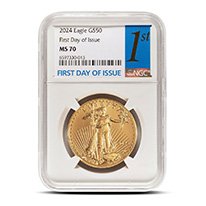
The most common Certified Bullion Gold Eagle coins have the grades of MS 70 and MS 69. These grades identify coins as follows:
Additionally, the NGC and PCGS use a handful of other certification and designation terms for coins that help identify special visual characteristics or unique designations in production. These include the following:
When the NGC and PCGS grade coins, proof or bullion, they use a numeric scale known as the Sheldon scale, which runs from 1 to 70, with the former identifying the lowest possible grade and condition, while the latter identifies a truly perfect and flawless coin. While the spectrum of possible grades is quite wide, the most commonly issued grades by the NGC and PCGS are 69 and 70, respectively.
As you browse the JM Bullion catalog of Proof Certified American Gold Eagle Coins, you’ll come across a variety of terms that may seem unfamiliar. Below you’ll find a breakdown of the commonly used terms so you better understand the value and condition of the Proof Certified American Gold Eagle coins you’re viewing in our online catalog:
When you decide on an American Gold Eagle coin from JM Bullion, you’ll find that we proudly accept a variety of payment methods for the American Gold Eagle you purchase. We accept most major credit/debit cards, with an average one-business-day processing time. Bank wire and PayPal transactions are processed immediately, releasing your coins into our shipping queue the fastest. Paper check payments are accepted, but take an average of four to six business days to process. Paper check, ACH, and bank wire transactions qualify for a 4% discount.
All JM Bullion shipments over $199 qualify for free shipping and insurance. We package all products in discreet boxes to protect the identity of your shipment. All packages are sent out via UPS or the US Postal Service, with expedited shipping available from both carriers with an additional fee. If your shipment is lost or stolen, we’ll work to provide you with a replacement product (if possible) or a refund of your purchase price.
If you have any questions about the American Gold Eagle, don’t hesitate to reach out to JM Bullion. Our associates are available on the phone at 800-276-6508, online using our live web chat feature, or via email. On our website you’ll also find the price of gold and silver updated live throughout the day!
Subscribe to the JM Bullion newsletter to receive timely market updates and information on product sales and giveaways.
MAJOR PAYMENT METHODS ACCEPTED


© Copyright 2024 JM Bullion. All Rights Reserved.